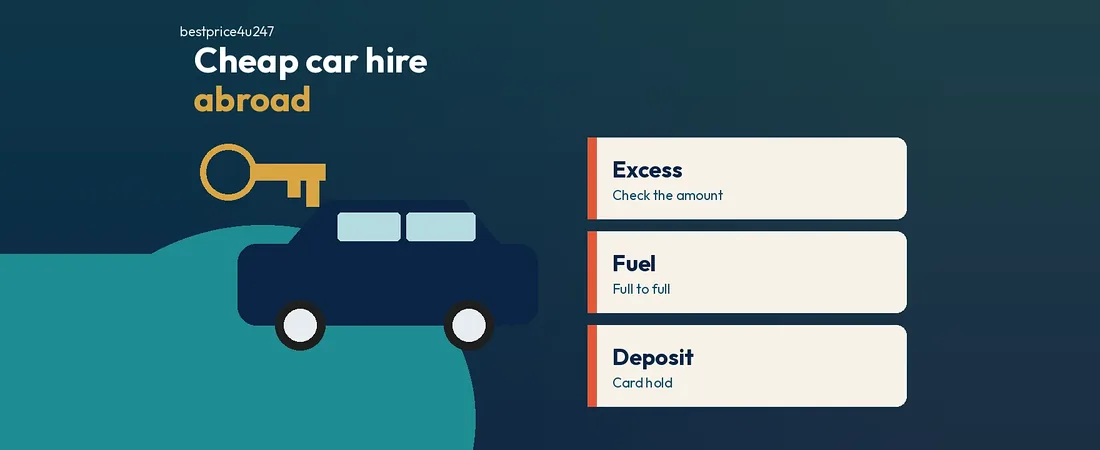
The secret to cheap car hire abroad is not the daily rate on the search results. It is the extras that appear later: the insurance excess, the fuel policy and the deposit held on your card. This guide explains those charges in plain English, so you can compare the real cost and pick up the keys with fewer surprises.
Written 26 November 2026. Hire terms change by country and company, so always read the conditions before you pay.
Compare the total cost, not the daily rate
The first price you see often covers the hire itself, for one driver, with basic cover and a tight mileage or fuel rule. Extras can then double what you thought you would pay. The cheapest result is only a bargain if the terms fit the trip you are actually taking.
Before you book, write down one total for each option. Include the hire, any additional driver, the fuel rule, child seats, one-way or cross-border fees, and the insurance you plan to use. Then compare those totals, not the headline rates. That is the only fair way to judge cheap car hire abroad.
Also check the currency, and whether the quote already includes local taxes. A quote in euros can look different once it sits next to a quote in pounds. Use the same dates, the same car group and the same pick-up point, or the comparison is not fair.
Understand the excess before you buy more cover
In Europe, hire companies include basic third-party insurance. Which? explains that most hires also include a collision damage waiver, often called CDW. That waiver is not the end of the story. You are still left with an excess, which is the amount you would pay towards repairs.
Which? reports that this excess can be as much as £2,500. It can apply even when the damage was not your fault, depending on the terms. That is why the desk often offers extra cover to reduce or remove the excess. It can feel like the only safe choice when a queue is forming behind you.
There is another way. You can buy specialist excess reimbursement insurance before you travel. Which? has found that this is usually cheaper, and more thorough, than the cover sold at the hire desk. If you use it, the hire company will still hold a deposit. If there is damage, you may have to pay first and claim it back, so read the policy and keep every document.
Do not assume your UK car insurance covers a hire car abroad. Check with your insurer if you are unsure. Also check whether your travel insurance includes any car-hire excess cover, and what it excludes, such as tyres, glass, the underbody or misfuelling.
Watch the deposit and the card hold
Almost every hire company takes a security deposit, or places a hold on your card, until the car comes back. The amount varies, and it can be large. You need enough unused credit, or available funds, to cover it as well as the hire itself.
Many firms will only take this deposit on a credit card in the main driver’s name. Many desks will not accept a debit card for this part, even if they accept one for the hire itself. Plenty of firms also refuse prepaid cards and some travel cards. Check the terms before you travel, so you are not stuck at the desk.
The company should release the hold after you return the car in the agreed condition. It can take several days, and sometimes longer, to leave your account. Keep the return report and take photos, in case you need to query a charge later.
Choose a fair fuel policy
Fuel is one of the easiest places to overpay. A fair fuel policy is one of the simplest ways to keep cheap car hire abroad cheap. Which? recommends a full-to-full policy, where you collect the car with a full tank and return it full. If you forget to refill, the company can charge you for the missing fuel and a refuelling fee, so build in time for a nearby petrol station.
Prepaid or full-to-empty policies can look convenient, because you do not have to refill at the end. You often pay for a full tank at a set price, though, and firms rarely refund the fuel you do not use. Unless you return the car almost empty, that option usually costs more.
Keep the fuel receipt if you refill before return. It is a simple record if the tank level is later disputed.
What cheap car hire abroad really costs
Once excess, fuel and the deposit are clear, look at the other add-ons. This is where cheap car hire abroad either stays cheap or quietly climbs. The common extras are easy to miss on a long booking page, so go through them one by one.
- Additional drivers. A second driver often adds an extra daily fee. If you will share the driving, add it now, because an undeclared driver can invalidate the cover.
- Age limits. Some firms add a fee, or will not hire, to younger or older drivers. Check the minimum and maximum age for the car group you want.
- One-way fees. Collecting in one place and returning in another can add a fixed charge. It is sometimes still worth it, but it should sit in your total.
- Cross-border rules. Some firms ban, restrict or charge extra for taking the car into another country. Ask before you plan a border crossing.
- Mileage. Some deals offer unlimited miles. Others include a set allowance and then charge for each extra kilometre or mile. Estimate your route before you choose.
- Child seats and extras. A seat from the hire desk is convenient, but packing your own can be cheaper if airline rules allow it.
If you want cheap car hire abroad after a cruise, those extras matter just as much. Our guides to Canary Islands cruises from Southampton and cruise deals for over-60s can help you plan the sailing. Then you can compare a car for the days ashore, or after you dock.
Take the right licence, and check whether you need an IDP
Take your valid UK driving licence. GOV.UK’s driving abroad guidance is the official place to check the rules for the country you are visiting. If your licence is lost, damaged or about to expire, replace it before you travel.
An international driving permit, known as an IDP, is required in some countries. Holders of a UK photocard licence do not usually need one in the EU, Switzerland, Norway, Iceland or Liechtenstein. A paper licence, or a licence from Gibraltar, Guernsey, Jersey or the Isle of Man, can be a different matter. Other countries have their own rules, and some hire companies still ask for an IDP even when the country does not require one.
Check the GOV.UK IDP page for the country, and then check with the hire company. If you need an IDP, you can get one in person from certain shops that have PayPoint. GOV.UK currently lists the fee as £5.50, and you must take your licence with you. An IDP does not replace your licence.
Hire companies may also ask for a licence check code. GOV.UK lets you create one, up to 21 days before you travel, through the view your driving licence service. If you hold a Northern Ireland licence, you may need to show the paper counterpart instead.
At the desk: inspect the car and keep records
The booking is only half the job. When you collect the car, walk around it in good light and take photos or a short video of the bodywork, wheels, glass and the interior. Point out any existing mark and make sure the staff write it on the check-out report before you leave the forecourt.
Confirm the fuel level, the mileage, the insurance excess and what is in the car, such as a warning triangle or a high-visibility jacket. GOV.UK notes that it is your responsibility, when you hire, to check you have the equipment the country requires. Do not rush this step, even if a queue has formed.
Do the same on return. Photograph the fuel gauge and the parked car, and keep the return report. If you later see a damage or refuelling charge you do not recognise, those records are what you will need.
Compare cheap car hire abroad with our search
When you know the dates and the pick-up area, use the search below to compare cheap car hire abroad. Compare the total price and the terms, not just the daily rate. Then read the excess, fuel policy and deposit before you pay. You can also start from the car hire search on our homepage.
Flights by Aviasales, hotels by Booking.com, car hire by Localrent.
Quick checklist
- Have you compared a total price, including extras, not just the daily rate?
- Do you know the excess, and how you will cover it?
- Can your card take the deposit, in the main driver’s name?
- Is the fuel policy full-to-full, or a prepaid tank?
- Have you checked age limits, mileage, one-way and cross-border rules?
- Do you need an IDP, and have you got a licence check code if asked?
- Will you photograph the car at pick-up and return?
Get those checks right and cheap car hire abroad is much less likely to produce a nasty bill at the desk. If a quote still looks unclear, get in touch and we will tell you what we would check next.